
Can You Open a U.S. Bank Account Without an SSN Online?
Some newcomers can open an account without an SSN, but whether the entire process can be completed online depends on the financial institution and the identification it can verify remotely.
An SSN is not universally required for every U.S. bank or credit-union account. CFPB states that you do not need a Social Security number to get a bank or credit-union account. But an institution still has to verify your identity, and its online application may support fewer document types than an in-person branch. If the online form requires an SSN or cannot verify your documents, call the institution before repeatedly submitting applications.
- Published
- August 28, 2026
- Sources checked
- CFPB / FDIC / IRS (tax IDs)
Important: Bank and credit-union requirements vary by institution, account type, application channel, location, and customer circumstances.
Key Takeaways
- An SSN is common, but some institutions can verify eligible non-U.S. customers with other identification.
- Online and branch procedures can differ, so an online stop is not always a final eligibility decision.
- Call the exact institution or branch before visiting and bring more identification and address documentation than the minimum.
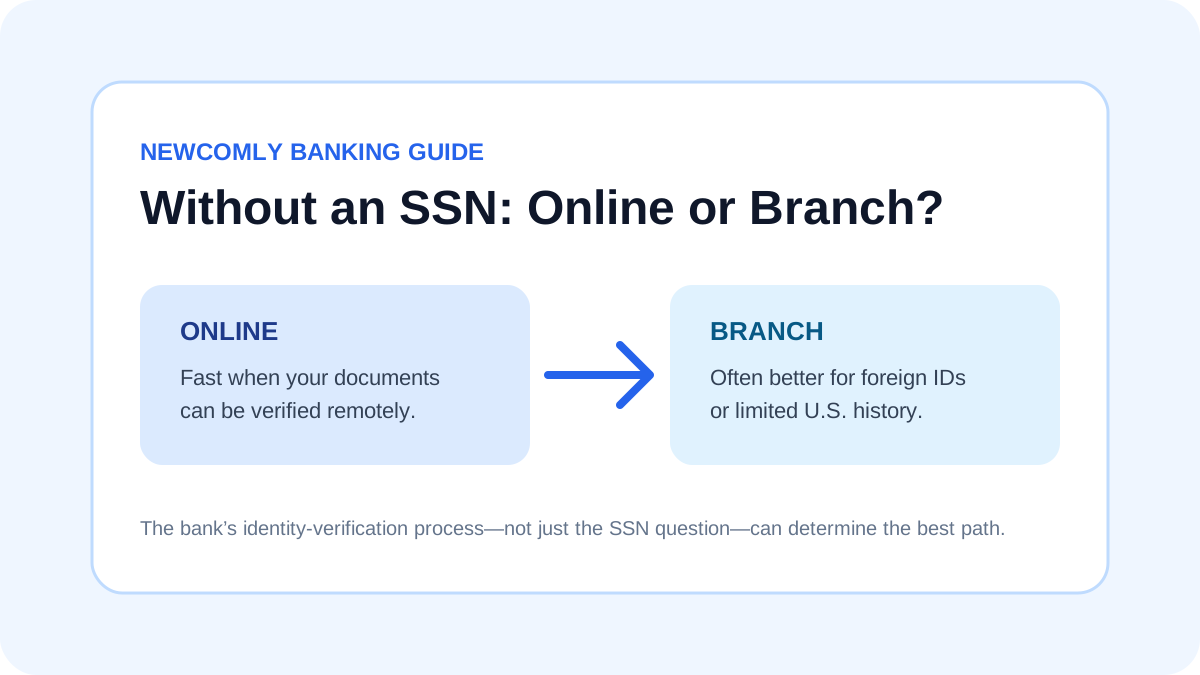
Why “without an SSN” and “online” are two separate questions
The first question is whether the institution can open the account for a customer who does not have an SSN. The second is whether its online identity-verification system can process the documents that customer has. A bank may have a lawful way to identify a non-U.S. person while still requiring that person to finish the process at a branch.
| If this happens online | Best next step |
|---|---|
| The application accepts your available identification and proceeds | Continue carefully and review fees, minimum balance rules, and account terms before submitting. |
| The form requires an SSN and offers no alternative | Do not invent a number. Call the bank and ask whether another account type or a branch application is available. |
| Your identity cannot be verified | Ask which original documents a branch can review and whether an appointment is recommended. |
| You have no U.S. address documents yet | Ask what proof of address the institution accepts; requirements vary. |
What identification may be relevant?
Federal customer-identification rules allow banks flexibility in how they identify non-U.S. persons. Depending on the institution, relevant identifiers can include a taxpayer identification number, passport number and country of issuance, an alien identification card number, or another government-issued document that evidences nationality or residence and includes a photograph or similar safeguard. The institution decides what it will accept under its own procedures.
What to prepare before starting an online application
- Your legal name, date of birth, and current address.
- A valid passport or other government-issued photo identification the institution says it accepts.
- An SSN or ITIN if you have one and the account requires it.
- Proof of U.S. address if requested.
- A way to fund the opening deposit if the account requires one.
Should you apply to several banks at once?
Usually, no. Start by checking the institution’s current documentation requirements and account terms. Multiple incomplete applications create confusion and do not solve a document mismatch. A nearby branch that regularly serves international students or immigrant communities may also be more familiar with alternative identification workflows.
FAQ
Do I need an SSN to open a bank account?
Not necessarily. CFPB explicitly says that you do not need a Social Security number to get a bank or credit-union account, although each institution decides what identification it accepts and which accounts it offers.
Can I use an ITIN instead?
Some institutions accept an ITIN for accounts that require a taxpayer identification number, but an ITIN does not guarantee approval. Check the institution’s current policy.
Is opening online easier than going to a branch?
Not always for newcomers. Online systems are convenient when they can verify your documents, but a branch may be better when you use a foreign passport, have limited U.S. address history, or need staff to review alternative identification.
Official and primary sources
- CFPB — Bank accounts and servicesExternal site ↗
- FDIC — Money Smart: You Can Bank On ItExternal site ↗
- Federal customer identification rule (FDIC archive)External site ↗
This article provides general educational information, not individualized legal, tax, immigration, or financial advice. Bank and credit-union policies can vary by institution, account type, location, and customer circumstances. Verify current requirements directly with the institution before applying.
Open a U.S. Bank Account Without an SSN Online? 2026 Guide
Some newcomers can open a U.S. bank account without an SSN, but a bank may require an in-person visit when its online system cannot verify alternative identification.
Use this decision path
If you have no SSN or ITIN, call the exact branch before visiting. If you have a passport and U.S. address, ask which non-U.S. customer identification the account accepts. If an online form stops at the SSN field, do not invent a number or keep resubmitting the same application—ask whether the bank offers a branch pathway.
Why online and branch requirements can differ
Banks must identify customers, but federal rules allow several forms of identification for non-U.S. persons. A bank still decides which documents and account-opening channels it supports. Automated online verification can therefore be narrower than an in-person review.
Your branch rescue plan
Call first and ask whether the specific account can be opened without an SSN, whether a foreign passport is accepted, whether an ITIN is required, what counts as proof of address, whether a second ID is needed, whether an appointment is recommended, and whether there is a minimum opening deposit.
Build a newcomer document folder
Bring your passport, applicable immigration or student documents, accepted proof of U.S. address, a second ID if requested, an ITIN letter if you already have one, and the phone/email you plan to keep. Never apply for an ITIN only because a bank form asks for a tax number; ITIN eligibility is based on federal tax purpose.
What happens after opening
Activate the debit card, enable account alerts, confirm ACH/direct-deposit details, learn the overdraft policy, download statements, and update the bank later if your identification or tax-number situation changes. A bank statement can also become useful documentation for later housing and financial applications.
- Consumer Financial Protection BureauExternal site ↗
- Federal customer identification ruleExternal site ↗
Last reviewed: August 29, 2026
Online vs. branch: why “SSN required” can mean two different things
A bank may accept certain non-U.S. customers without an SSN but still require them to complete identity verification in a branch. Treat account eligibility and online eligibility as separate questions.
- Check the bank’s official application requirements, not only third-party lists.
- If the online form blocks you at SSN, ask whether passport-based verification is available in a branch.
- Never invent an SSN or submit false identification information.
- CFPB — Bank accounts and servicesExternal site ↗
- FDIC — Customer Identification ProgramExternal site ↗
- Chase — International student bankingExternal site ↗
- Bank of America — Account application FAQsExternal site ↗
- NerdWallet — Immigrant bank-account researchExternal site ↗
NEWCOMLY COMMUNITY
Questions & newcomer experiences
Ask a practical question, share what worked for you, or suggest a correction. Every submission is reviewed before it appears publicly.
Community notes
No public questions or experiences yet. You can be the first to contribute.