- Published
- August 13, 2026
- Sources checked
- CFPB / FDIC / IRS (tax IDs)
Important: Bank and credit-union requirements vary by institution, account type, application channel, location, and customer circumstances.
Key Takeaways
- An SSN is common, but some institutions can verify eligible non-U.S. customers with other identification.
- Online and branch procedures can differ, so an online stop is not always a final eligibility decision.
- Call the exact institution or branch before visiting and bring more identification and address documentation than the minimum.
Updated August 12, 2026
You just arrived in the U.S., and suddenly every financial form seems to ask for a Social Security Number you don’t have.
You need somewhere for your paycheck to go. You need a debit card. You may need to pay rent, utilities, or a phone bill. But you keep seeing the same box:
Social Security Number.
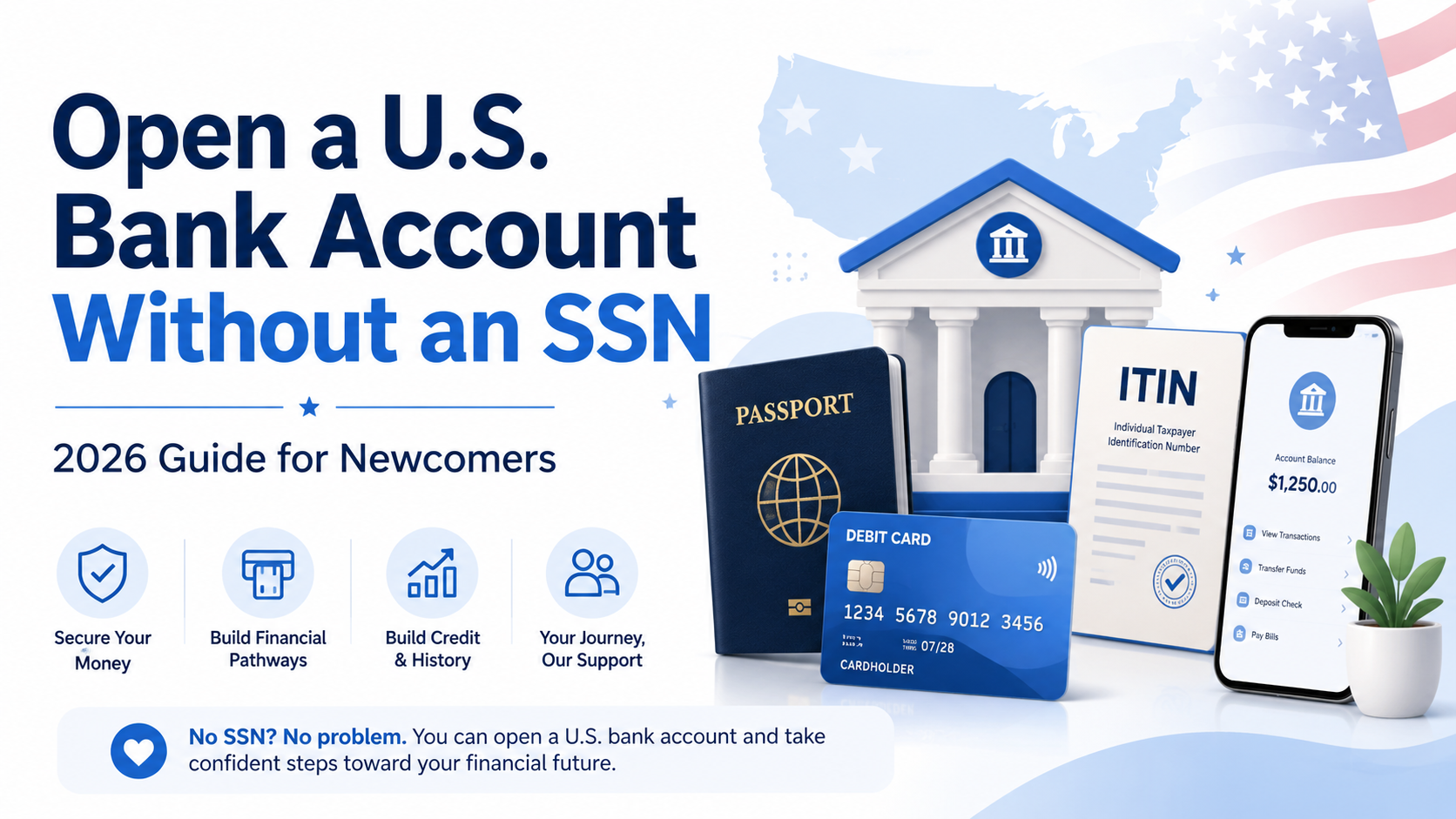
The good news is that not having an SSN does not automatically prevent you from opening a U.S. bank account.
Depending on the bank and your immigration status, you may be able to use an ITIN, foreign passport, foreign tax identification number, or other government-issued identification instead.
Here is where I would start if you’re new to the U.S.
Quick Answer: Where Should You Start?
| Your situation | Best place to start | SSN required? | Where to apply |
|---|---|---|---|
| No SSN or ITIN yet | Wells Fargo | Alternative ID may be accepted for non-U.S. citizens | Branch |
| International student | Bank of America or Chase | May not be required depending on the program | Usually branch |
| Already have an ITIN | Major U.S. banks | SSN usually not necessary if ITIN is accepted | Depends on bank |
| Mainly sending money internationally | Wise | Verification requirements vary | Online |
| Settling in the U.S. long-term | Traditional bank | ITIN makes your options easier | Branch is often easiest |
If you have no SSN and no ITIN at all, Wells Fargo is one of the clearest major-bank options to investigate first. Its current branch-opening instructions specifically explain what non-U.S. citizens without a U.S.-issued taxpayer identification number should bring.
Why Do Banks Ask for an SSN?
Here’s the part that can be confusing when you’re new to the country:
Banks aren’t asking for an SSN simply to keep people without one from opening accounts.
U.S. financial institutions are required to have procedures for verifying the identity of people opening accounts. For a non-U.S. person, federal Customer Identification Program rules allow identification information such as a taxpayer ID, passport number, alien identification number, or certain other government-issued identification numbers.
The exact documents a bank accepts, however, depend on that bank’s policies.
That is why you can walk into one bank and be told you need an ITIN while another bank may have a process for opening an account with a foreign passport and additional identification.
What Should You Bring to the Bank?
Requirements vary, but if you’re opening an account without an SSN, I would bring as much documentation as possible.
1. A government-issued photo ID
Your passport is usually the most useful document.
Depending on the bank, other acceptable identification may include:
- Foreign passport
- U.S. or foreign driver’s license
- Consular identification card
- Employment Authorization Document
- Student ID as a secondary form of identification
2. Proof of your U.S. address
Banks commonly ask for a physical U.S. address.
Possible documents include:
- Utility bill
- Rental agreement or lease
- Bank or credit card statement
- Employer document or pay stub
- School enrollment document
- Other official mail showing your name and address
The exact document list varies by bank.
3. A second form of identification
This becomes especially important when you don’t have an SSN or standard U.S. identification.
For example, Wells Fargo requires two forms of identification for branch openings and lists items such as another government ID, debit or credit card, employee ID, or student ID as possible secondary identification.
4. Your ITIN or foreign tax ID, if you have one
If you’ve already received an ITIN, bring it.
International students may also be able to use a foreign tax identification number under certain bank programs.
5. Phone number and email
You’ll normally need these to manage online banking, receive security alerts, and access your account.
Option 1: Wells Fargo — One of the Clearest Options Without an SSN
If you currently have neither an SSN nor an ITIN, Wells Fargo is one of the first traditional banks I would check.
For Wells Fargo Everyday Checking, online applicants need an SSN or ITIN. But its branch-opening guidance says that non-U.S. citizens without a U.S.-issued taxpayer identification number must provide government-issued identification showing nationality or residence.
The bank also asks branch applicants for primary and secondary identification and may require separate proof of address.
Try the branch rather than the online application.
Bring your passport, another form of acceptable identification, and proof of your U.S. address.
Check Wells Fargo’s current identification requirementsExternal site ↗
Option 2: Chase — Especially Worth Checking for International Students
Chase publishes guidance specifically for non-residents opening U.S. bank accounts.
Its guidance says non-residents may need government-issued photo identification and proof of a U.S. address. Examples of identification listed by Chase include a passport, Matrícula Consular Card, driver’s license, student ID, and Employment Authorization Card.
Chase also states that international students may not need an SSN to open a checking account and generally directs international students opening accounts to visit a branch with acceptable identification.
So if you’re an international student, Chase is worth checking.
For other newcomers without an SSN, don’t assume every Chase account can be opened without one. Call a branch first and explain your immigration and identification situation.
See Chase’s guide for non-U.S. residentsExternal site ↗
Option 3: Bank of America — Very Good for International Students
Bank of America is a good example of why your immigration situation matters.
For U.S. visa holders who are living in the United States as nonpermanent residents, Bank of America’s general guidance says applicants can open an account in person but should provide both their foreign and local address and an ITIN.
But there is an important exception.
Bank of America’s dedicated international student program says international students can use a Foreign Tax Identification Number (FTIN). A U.S. TIN or ITIN isn’t required unless one has already been issued to the student.
The student also needs a foreign and U.S. address plus two forms of identification.
Bank of America may be one of your best options.
If you’re another type of visa holder without an SSN or ITIN, check the requirements before visiting because the general program may require an ITIN.
See Bank of America’s international student banking informationExternal site ↗
Option 4: Citi — Better Once You Have an ITIN
Citi would not be my first stop if you have neither an SSN nor an ITIN.
Citi’s current online banking requirements say that online applicants must be U.S. citizens or U.S. resident aliens, and the identification information requested may include an SSN or ITIN.
That makes Citi a more practical option after you have an ITIN or otherwise meet its eligibility requirements.
If your goal is simply to get your first U.S. account established as quickly as possible, I would check Wells Fargo, Chase, or an applicable Bank of America international program before Citi.
Option 5: Get an ITIN
If the bank you want requires an ITIN, getting one can make your financial life in the U.S. much easier.
An ITIN — Individual Taxpayer Identification Number — is a nine-digit tax processing number issued by the IRS to people who need a U.S. taxpayer identification number for federal tax purposes but aren’t eligible for an SSN.
An ITIN does not give you permission to work in the United States.
You apply using IRS Form W-7.
You can generally apply:
- By mail
- At certain IRS Taxpayer Assistance Centers
- Through an IRS-authorized Certifying Acceptance Agent
If you’re applying with a passport, the IRS says a qualifying foreign passport can serve as the only document needed to establish both foreign status and identity in many cases.
How long does an ITIN take?
Don’t think of an ITIN as an instant workaround.
As of 2026, the IRS says to allow about 7 weeks for notification of your application status.
It can take 9–11 weeks during tax season — January 15 through April 30 — or if you apply from overseas.
Also, applying directly to the IRS itself does not require paying someone hundreds of dollars. Agents or tax professionals may charge for their own services, but the ITIN itself is issued by the IRS.
See the IRS instructions for applying for an ITINExternal site ↗
What About Wise?
Wise can be useful for newcomers, especially if you’re transferring money between the U.S. and another country.
But there’s an important detail that many older articles get wrong:
Don’t assume Wise simply means “no SSN required.”
Wise says that people living in the U.S. may be asked for an SSN or ITIN when using certain U.S. features or services.
However, Wise also says that in some verification situations users may be able to verify themselves using identification and a selfie, and non-U.S. citizens may be asked for non-U.S. identification.
So I would think of Wise as a useful international money-management and transfer option, not as a guaranteed replacement for a U.S. checking account.
If your main goal is sending money between countries, it is worth checking your current eligibility.
If you’re settling permanently in the U.S., I would still work toward establishing a traditional U.S. banking relationship.
Check Wise’s current U.S. verification requirementsExternal site ↗
What About Revolut?
You may see older articles recommending Revolut to people without an SSN.
Be careful with that advice.
Revolut’s current U.S. Customer Identification Program says a personal account applicant must be at least 18 and be a U.S. citizen or resident alien with a valid SSN, along with a residential address in an area where Revolut offers the account.
For that reason, Revolut is not one of my recommended no-SSN options in 2026.
This is also a good reminder that fintech requirements change. Always check the current rules rather than relying on an article from two or three years ago.
So Which Option Should You Choose?
Here’s the simplest way I would approach it.
You have no SSN and no ITIN
Start by calling a Wells Fargo branch and asking what identification they require for a non-U.S. citizen without a U.S. taxpayer identification number.
You’re an international student
Check Bank of America and Chase.
Both have specific resources for international students, and Bank of America specifically allows a foreign tax identification number in its international-student process.
You already have an ITIN
Your choices become much broader.
Compare traditional banks based on:
- Monthly fees
- Minimum-balance requirements
- ATM access
- Branch locations
- Direct deposit requirements
- Future credit-card options
You mainly need international transfers
Check Wise and compare its current fees and verification requirements with your home-country bank and U.S. bank.
You’re planning to stay in the U.S. long-term
I would prioritize establishing a traditional U.S. bank account.
Your checking account itself doesn’t create a credit score, but having your finances organized makes the next steps — getting your first credit card and building credit — much easier.
Frequently Asked Questions
Can I really open a U.S. bank account without an SSN?
Yes, in some situations.
Federal identity-verification rules provide alternative identification methods for non-U.S. persons, but each financial institution sets its own account-opening procedures.
Wells Fargo, for example, specifically publishes branch guidance for non-U.S. citizens without a U.S.-issued taxpayer identification number.
Do I need an ITIN to open a bank account?
Not always.
It depends on the bank and your status.
Some banks or programs may accept alternative identification or a foreign tax identification number. Others may require an ITIN.
Can international students open U.S. bank accounts without an SSN?
Yes, depending on the bank.
Chase says international students may not need an SSN, while Bank of America’s international-student program accepts an FTIN and says a U.S. TIN or ITIN isn’t required unless one has already been issued.
Can I open the account online?
Possibly, but a branch is usually your best bet when you don’t have an SSN.
For example, Wells Fargo requires an SSN or ITIN for online Everyday Checking applications, while its branch instructions provide an identification path for non-U.S. citizens without a U.S.-issued taxpayer ID.
Will opening a checking account build my credit score?
No.
Checking and savings accounts normally aren’t credit accounts, so simply opening one does not establish a traditional credit history.
Building credit is a separate step.
Will I get a debit card?
Checking accounts generally provide access to a debit card, although the exact account features depend on the bank and product.
What if I get an SSN later?
Contact your bank and ask them to update your tax identification information.
You don’t normally need to close the account simply because you later receive an SSN.
The Bottom Line
When you first arrive in America, not having an SSN can make it feel like every door is locked.
It isn’t.
If you’re a non-U.S. citizen without an SSN or ITIN, Wells Fargo is one of the clearest major banks to check first because it publishes an alternative identification process for branch openings.
If you’re an international student, Chase and Bank of America are especially worth checking.
If a bank requires an ITIN, getting one can open up many more banking options — just remember that the process can take several weeks.
And if you’re moving money internationally, Wise may be useful, but check its current verification requirements rather than assuming no SSN will ever be requested.
Getting your first bank account is only the beginning.
Once your money has a home, the next big challenge for most newcomers is building a U.S. credit history.
Information in this article is current as of August 12, 2026. Bank account requirements can change and may depend on your immigration status, location, account type, and individual circumstances. Always confirm current requirements directly with the financial institution before applying.
ANSWERING THE QUESTIONS PEOPLE SEARCH
Do You Need an SSN to Open a U.S. Bank Account?
Not always. The Consumer Financial Protection Bureau states that you do not need a Social Security number to get a bank or credit-union account. Financial institutions still must verify identity, and each institution decides which documents and account-opening methods it accepts.
Can You Open a Bank Account Without an SSN Online?
Sometimes, but the online channel can be more restrictive than the institution’s overall policy. If the form requires an SSN and offers no alternative, do not enter false information. Ask whether the institution supports another account type or an in-person identity-verification path.
What Can You Use Instead of an SSN?
For non-U.S. persons, federal customer-identification rules give banks flexibility to use certain alternative identifying information, such as a passport number and country of issuance or other qualifying government-issued documents. The bank determines what it will accept under its procedures, so call the specific institution before visiting.
International Students: What Should You Bring?
Ask the branch whether it wants your passport, school ID, immigration/student documents, and proof of U.S. address. Students living in dorms or temporary housing should specifically ask what the bank accepts as proof of address.
PRACTICAL DECISION GUIDE
Before you choose a bank, compare the process—not just the account
For a newcomer without a Social Security number, the biggest difference between banks may be the identity-verification process. Before visiting, call the exact branch and ask whether it can review a passport and other alternative identification in person. Online applications are convenient, but they can be less flexible when an automated form expects an SSN.
| Ask before you apply | Why it matters |
|---|---|
| Can this branch open an account for someone without an SSN? | Policies and staff familiarity can vary by institution and location. |
| Which primary and secondary IDs are accepted? | It prevents a wasted trip with the wrong documents. |
| What proof of U.S. address is accepted? | New arrivals may not yet have a utility bill or long rental history. |
| Is there a minimum opening deposit or monthly fee? | A “starter” account should still fit your actual cash flow. |
Newcomer application file
- Current passport and available immigration documents
- Reliable U.S. mailing address and proof accepted by that institution
- Second ID if requested
- ITIN or tax information only when it actually applies to you
- Phone number and email you can continue using
If the first bank says no
A denial at one institution does not mean every bank or credit union uses the same documents or verification process. Ask what requirement was missing, keep the explanation, and compare another institution rather than repeatedly submitting the same online form.
Opening a U.S. bank account without an SSN: what actually determines your next step
Strong consumer guides tend to answer the same first question—“Is it possible?”—but newcomers usually need a second layer: which application path is most realistic for my documents today? Bank policies differ, and online identity systems can be less flexible than an in-person review. Treat the account-opening process as a document-matching problem, not a hunt for a universal “no-SSN bank.”
Start with this 5-minute decision check
| Your situation | Best next move | What to ask |
|---|---|---|
| You have an SSN | Compare normal checking accounts online or in branch. | Monthly fee, waiver, minimum balance, overdraft settings. |
| No SSN, but you have an ITIN | Ask whether that specific account accepts an ITIN. | Can identity verification be completed online or only in branch? |
| No SSN or ITIN yet | Call a branch before applying. | Which foreign ID/tax ID and U.S. address documents are accepted? |
| International student | Ask about student/non-permanent resident procedures. | Passport, school ID/I-20, address proof, second ID, tax-number policy. |
Build a “branch-ready” folder
- Valid passport and any current U.S. immigration document you already have.
- A second ID if the institution asks for one.
- U.S. address evidence the bank says it accepts.
- SSN, ITIN, or foreign tax-identification information only when legitimately applicable.
- Opening-deposit method and a phone/email you can keep using.
What to compare besides “Can I open it?”
For the first year, predictable costs often matter more than a welcome bonus. Compare monthly maintenance fees and waiver rules, ATM access, overdraft/returned-item policies, international transfer costs, cash-deposit access, customer support, and how easily you can download statements. Statements can later become useful financial records when you apply for housing or other services.
Questions worth asking before you travel to a branch
- Can someone with my exact documents open this exact account?
- Do I need an appointment?
- Which address documents count, and how recent must they be?
- Is an SSN required, or can another tax/identity document be used?
- What fee will I pay if my balance stays low during my first few months?
Why this section is different: it is shaped around recurring questions found across high-visibility newcomer banking guides, while avoiding bank-by-bank promises that can become outdated. Institution-specific requirements should always be confirmed on the bank’s current official site or with the branch.
Can I open a bank account without a Social Security number?
Yes. The CFPB states that you do not need a Social Security number to get a bank or credit-union account. The practical question is which identification the specific institution accepts and whether you can apply online or need to visit a branch.
- Without an SSN or ITIN? A non-U.S. customer may be able to use qualifying alternative identification, such as passport information, depending on the institution.
- Online application stopped? Check whether the same account can be opened in person before assuming you are ineligible.
- International student? Bring your passport and applicable school/immigration documents, and confirm the bank’s current requirements before visiting.
- CFPB — Bank accounts and servicesExternal site ↗
- FDIC — Customer Identification ProgramExternal site ↗
- Chase — International student bankingExternal site ↗
- Bank of America — Account application FAQsExternal site ↗
- NerdWallet — Immigrant bank-account researchExternal site ↗
Open a U.S. Bank Account Without an SSN: the practical path
Start with your identity situation
Use your SSN if you already have one. If you do not, identify whether you have an ITIN, a passport, a foreign tax ID, and proof of a U.S. address. Do not invent a number or apply for an ITIN simply to fill a bank form.
What the federal rule means—and what it does not mean
Banks must verify identity. FDIC guidance explains that a U.S. person generally supplies a TIN, while a non-U.S. person can be identified with qualifying alternatives such as a passport number and country of issuance. This is an identity-verification framework—not a guarantee that every bank, account, or online channel accepts every document.
Call the exact branch before you go
Ask: Can this specific checking account be opened by a non-U.S. customer without an SSN? Which primary and secondary IDs do you accept? What counts as proof of U.S. address? Is an in-person appointment required? Is there a minimum opening deposit or monthly fee?
Build one document packet
Bring an unexpired passport; accepted proof of U.S. address; a second ID if available; immigration or student documents that apply to you; an ITIN only if you already legitimately have one; and a stable phone number and email.
If the online form stops at SSN
Treat account eligibility and online eligibility as separate questions. A bank can support a non-SSN customer in a branch even when an automated web flow is narrower. Stop before entering false information and ask whether branch verification is available.
If you have neither an SSN nor an ITIN
Some non-U.S. customers may still have an alternative-ID pathway. CFPB consumer guidance says an SSN is not required in every case to obtain a bank or credit-union account. Bank of America also currently states that an SSN is not required for its international-professional process, although its documentation and appointment rules still apply.
After the account opens
Activate the debit card and alerts, learn the overdraft policy, save account and routing details securely, download your first statement, and update the institution later if your tax-identification situation changes.
NEWCOMLY COMMUNITY
Questions & newcomer experiences
Ask a practical question, share what worked for you, or suggest a correction. Every submission is reviewed before it appears publicly.
Community notes
No public questions or experiences yet. You can be the first to contribute.